
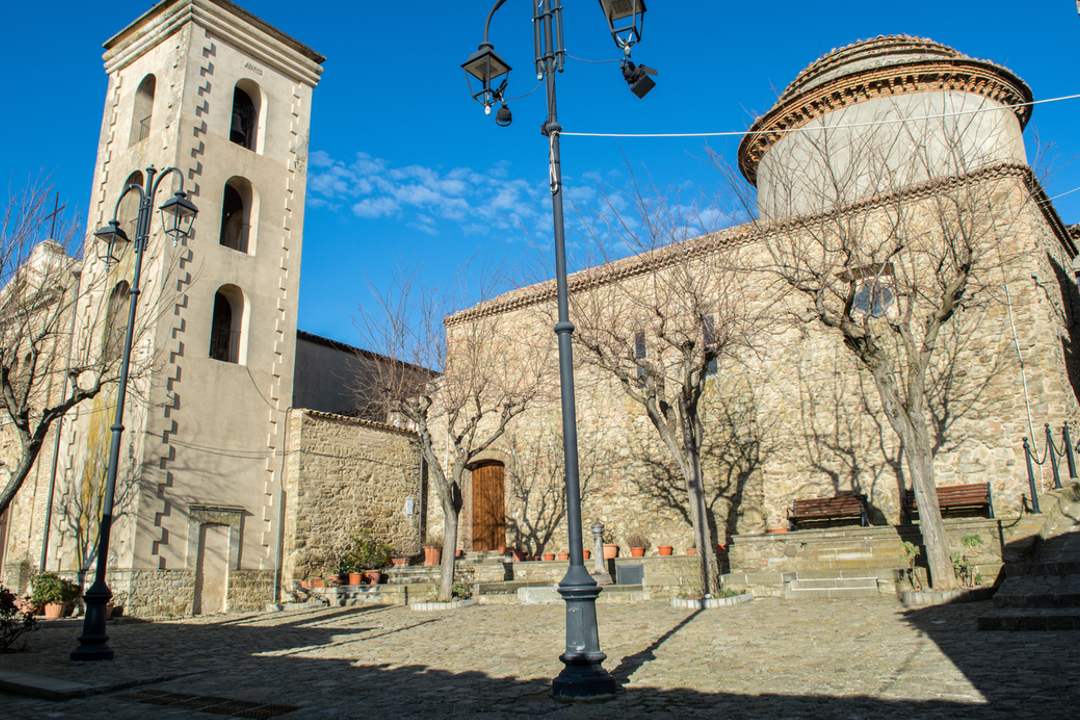
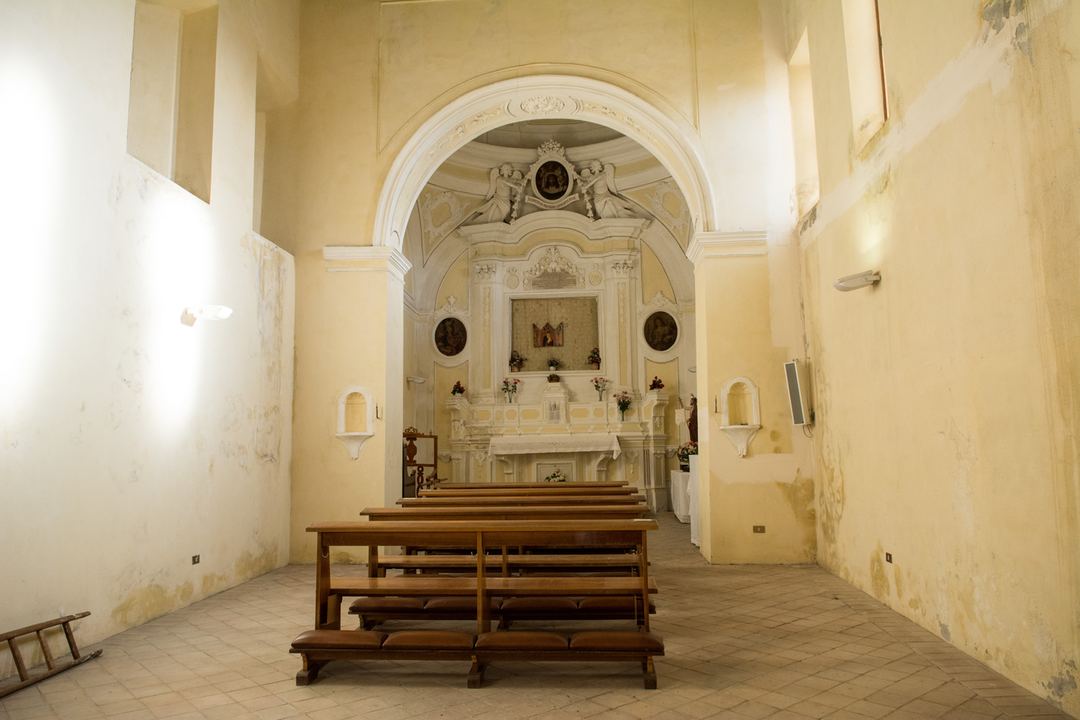


Eretta probabilmente tra il ‘400 e il ‘500 in adiacenza alla Chiesa Madre e contigua al Castello con cui era collegata anche sotterraneamente, risente dell’influsso di vari stili architettonici, probabilmente dovuti anche agli interventi succedutisi tra i Principi che hanno detenuto il Castello. L’esterno è stato realizzato sempre con pietra locale anche se denota influssi dell’arte asiatica, la cupola invece pare essere influenzata da elementi decorativi normanni ed è molto simile a quella di Santa Maria del Patirion di Rossano Calabro. Un’iscrizione in latino all’interno della Cupola ci informa che “Questo tempio gentilizio sotto il titolo della Vergine della Cona, fatto costruire come si tramanda da Cecinella Carafa, principessa della terra di Colobraro, rovinato ormai da tempo, donna Maria Maddalena Carafa dei Marchesi Tortorelli, moglie del Marchese Giulio Cesare Donnaperna e banoressa della medesima terra, a sue spese fece restaurare, ornare e riportare ad un migliore e nuovo aspetto. Anno del Signore 1794”. La Cappella fu quindi restaurata e arricchita di decorazioni e stucchi e negli anni ’60 ne è stato rifatto anche il pavimento. La Cona era abbellita da alcuni quadri di pregio ora presso il Museo Lanfranchi di Matera: il Trittico raffigurante la Madonna col Bambino, di cui se ne può ammirare una miniatura nella Cappella. Il quadro presenta negli sportelli laterali le immagini particolarmente espressive di Giovanni il Battista e di Giovanni Evangelista e vuol essere una “vivente premonizione della fine dei giorni”; al centro il volto della Vergine e l’aspetto del Bambino sono di una grazia toccante, ma colpisce soprattutto la freschezza dei colori dell’intera opera. La pregiata opera fu realizzata da un francescano rimasto anonimo appartenente alla scuola napoletana dei seguaci di Giotto (Giotto fu a Napoli dal 1329 al 1333). La Pala di Altare, raffigurante la Madonna col Bambino e San Leonardo, contiene in basso anche le immagini dei due notabili locali che lo hanno commissionato, ritratti in caratteristico abbigliamento del tempo mentre devolvono un’offerta a San Leonardo. L’opera di fattura artistica pregevole è stata eseguita nella seconda metà del ‘500 dal pittore napoletano Francesco Curia
This chapel was probably built between the 15th and 16th century, adjacent to the mother church and next to the castle, to which it was also connected by an underground tunnel. The chapel shows the influence of different architectural styles, probably due to the many restoration works carried out during the years by the various princes who held the castle in time. The exterior was realized with local stone, although it reveals Asian art influences. The dome instead seems to have been influenced by Norman decorative elements and is very similar to the Santa Maria del Patirion's dome of Rossano Calabro. A Latin inscription inside the dome tells us that “The construction of this noble temple, entitled to the "Vergine della Cona", was ordered, according to the tradition, by Cecinella Carafa, Princess of Colobraro. Ruined long ago, Maria Maddalena Carafa dei Marchesi Tortorelli, wife of the Marquis Giulio Cesare Donnaperna and Baroness of the same village, had it restored, decorated and brought back to a better and new appearance at her own expenses. The year of our Lord 1794.” The chapel was then restored and enriched with decorations and stuccos, and in the 1960s also the floor was replaced. The Cona was adorned with some valuable paintings, which are now at the Lanfranchi Museum of Matera: the Triptych representing the Virgin with child, whose miniature can be admired in the chapel, includes very expressive images of John the Baptist and John the Evangelist in the side doors and wants to be a “living premonition of the end of days”. The Virgin and the child in the center of the painting have a touching, graceful aspect. The freshness of the colors that enliven the entire work moves the spirit of everyone. This precious artwork was realized by a Franciscan remained anonymous, belonging to the Neapolitan school of Giotto, who, in fact, was in Naples from 1329 to 1333. On the bottom of the altar-piece, depicting the Virgin with child and Saint Leonard, there are the images of the two local nobles who commissioned it, represented in the typical clothing of the time, while they devote an offer to Saint Leonard. The work, of fine artistic quality, was realized in the second half of the 16th century by the Neapolitan artist Francesco Curia.
Territorio
 Convento e Chiesa
 Timpa della Rocca
 Palazzo delle Esposizioni
 Magia e Fascinazione
 Il Castello
Dove Dormire
Dove Mangiare
Numeri Utili
EMERGENZA
Numero Nazionale Emergenza 112
Soccorso Sanitario 118
Vigili del Fuoco 115
Carabinieri 0835 841010
UFFICIO POSTALE
Corso Umberto I n.109
75021 - Colobraro (MT)
+39098524412